
What happens when your WordPress site breaks and no one is there to fix it?
A plugin clashes with your theme. Your contact form stops sending leads. And the freelancer who built your site? Gone, with no reply and no record of what they changed.
This is what happens once a WordPress site grows past the basics. So what are the benefits of hiring a dedicated WordPress developer? You get one person who knows your site inside and out, fixes problems fast, and builds it to handle growth rather than breaking under the load.
Here’s what this article covers:
- What does “dedicated WordPress developer” actually mean
- Why a dedicated developer beats a freelancer or DIY setup
- The core benefits: performance, security, custom features, SEO, and scale
- When you should actually hire one (and when you shouldn’t, yet)
- Whether it’s worth the cost
- How to pick the right person or team
What Does “Dedicated WordPress Developer” Actually Mean?
A dedicated WordPress developer is someone who works with your website on an ongoing basis, not just for one job and then a goodbye email. Think retainer, not one-time invoice.
This is different from the three other setups people often lump together:
- Freelancer for a single project: builds the site, hands it over, moves on to the next client.
- In-house hire: a full-time employee, on payroll, dedicated to your company alone.
- Dedicated developer (agency or independent): an ongoing working relationship, usually through a retainer or recurring contract, where the same person stays familiar with your site over months or years.
You get the continuity of in-house without the salary, benefits, and hiring overhead. That’s the trade-off worth understanding before you commit to anything. If you want a full breakdown of how this hiring model actually works, see our guide on how to hire a WordPress developer.
What Are the Benefits of Hiring a Dedicated WordPress Developer?
If you are still trying to figure out whether you need to hire WordPress developers, then this is the perfect time to tell you about the benefits of hiring dedicated WordPress developers.
Below are 6 core benefits of hiring a dedicated WordPress developer.
A dedicated WordPress developer,
- Improves Website Performance
- Strengthens WordPress Security
- Build Custom Functionality
- Supports Technical SEO
- Helps Your Website Scale
- Provides Ongoing Support and Maintenance
How Does a Dedicated Developer Improve Website Performance?
Speed isn’t a nice-to-have. Google found that as page load time increases from 1 second to 3 seconds, the chance of a visitor bouncing increases by 32%. That’s not a small dip. That’s a third of your visitors gone before they see anything.
A dedicated developer optimizes images, cleans up bloated code, sets up caching properly, and watches Core Web Vitals over time instead of fixing speed once and walking away. This matters because performance problems creep back in. A new plugin is added, a large image is uploaded, and suddenly your fast site is slow again. Someone who already knows your setup catches that early.
How Does a Dedicated Developer Strengthen WordPress Security?
WordPress’s popularity makes it a target. Most security holes don’t come from the WordPress core itself but from outdated or poorly coded plugins and themes sitting unpatched for months.
A dedicated developer handles updates on a set schedule rather than “whenever someone remembers.” They run backups, watch for malware, and close the gaps that a one-time security audit can’t catch, because security isn’t a single fix. It’s ongoing maintenance. The businesses that get hacked are usually the ones where nobody was watching.
What Custom Functionality Can a Dedicated Developer Build?
This is where a custom WordPress website earns its name. Plugin developers and theme customization specialists can build the exact booking flow, membership system, or CRM integration your business actually needs, instead of bending a generic plugin until it almost fits.
Custom functionality also means fewer plugins overall. Instead of stacking five plugins to approximate a single feature, a developer builds that feature directly, which keeps your site lighter and easier to maintain.
How Does a Dedicated Developer Support Technical SEO?
Good rankings start with the code, not the content. Clean site architecture, proper heading structure, working schema markup, and fast load times all feed into how well Google can crawl and understand your site. A developer who already optimized your Core Web Vitals for speed is solving half of this problem at the same time.
Technical SEO is also where DIY builds tend to quietly fall apart. Nobody notices broken schema or duplicate title tags until rankings start slipping, and by then, it’s been a problem for months.
How Does a Dedicated Developer Help Your Website Scale?
Website scalability is about decisions made today that don’t cause pain later. A developer who understands your business plans the site architecture so that adding a new feature, handling a traffic spike, or expanding into e-commerce doesn’t mean rebuilding from scratch.
This is the difference between a site that grows with your business and one that needs a costly redo every two years.
What Ongoing Support and Maintenance Does a Dedicated Developer Provide?
Plugin updates, theme updates, uptime checks, and quick fixes when something breaks: this is website support at its plainest. The advantage of dedicated support over hiring fresh each time is speed. A developer who already knows your codebase fixes a bug in minutes. A new freelancer needs hours to understand what they’re looking at first.
If you’re wondering what kinds of questions separate a developer who’ll actually deliver this from one who won’t, our list of questions to ask before you hire a WordPress developer is a useful gut check.
Why Hire a Dedicated WordPress Developer Instead of a Freelancer or DIY Build?
Because someone actually needs to remember what’s on your website. A freelancer disappears after the invoice clears – a DIY build runs on whatever knowledge you picked up from YouTube. Neither holds up once your site has real traffic, real customers, or real money riding on it.
What Problems Do DIY and Template-Based Sites Create?
Templates are built for everyone, which means they’re built for no one in particular. You get generic layouts, plugin stacking (one plugin for forms, another for SEO, another for speed, all fighting each other), and a site that looks fine until you try to do something specific. Booking systems, membership areas, and custom dashboards rarely come pre-built, and forcing them into a template usually breaks something else.
What Are the Risks of Hiring Freelancers Instead?
Freelancers work great for a one-time job. The risk shows up later. When your site goes down at 11 pm on a Friday, your old freelancer probably isn’t picking up. Quality also varies wildly between projects, since you’re starting fresh with someone new each time, explaining your site from scratch, paying for the ramp-up period all over again.
We’ve written more about this trade-off between freelance and agency WordPress developers, if you want the longer version.
When Should You Hire a Dedicated WordPress Developer?
When your site is doing real work for your business, and the cracks are starting to show. A few concrete signals:
- You’ve outgrown your template and need features it can’t support
- You’ve gone through more than one freelancer and keep starting over
- Traffic is growing, and your site is slowing down under it
- You’ve had a security scare, or you’re not sure your site is actually protected
- You’re planning to add e-commerce, memberships, or other complex functionality
If none of that applies yet, a dedicated developer might be more than you need right now. A small brochure site with no growth plans and no custom functionality can often run fine on a solid theme and occasional freelance help. The moment that changes, revisit the decision.
Is Hiring a Dedicated WordPress Developer Worth It?
For a business with an active, growing, or revenue-generating site, yes. The math isn’t about the invoice. It’s about what you avoid: downtime that costs sales, security incidents that cost trust, and rebuilds that cost far more than steady maintenance ever would.
Costs vary by setup. A retainer with a dedicated developer or a small agency typically costs less than a full in-house salary while still providing continuity. Project-based freelance work can look cheaper upfront, but the hidden cost is having to start over every time you need a new task done. For real numbers, our guide on WordPress developer costs breaks down what different setups actually run.
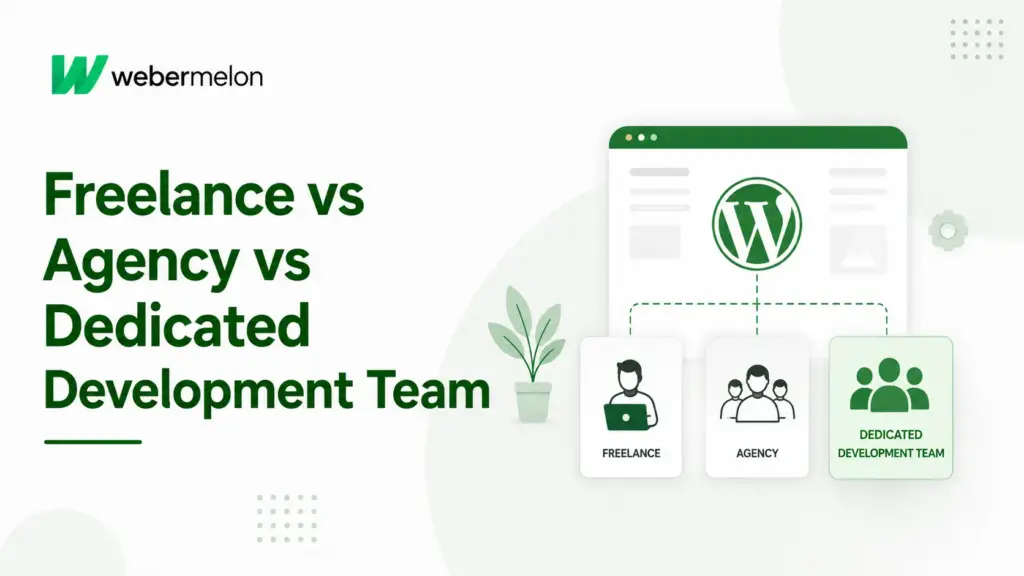
Dedicated Developer vs. Freelancer vs. In-House Team: Which Is Right for You?
It comes down to four things: cost, depth of expertise, continuity, and how much you need the site to scale.
| Factor | Freelancer | Dedicated Developer | In-House Team |
| Cost | Lowest upfront, costly over time | Moderate, predictable | Highest (salary + benefits) |
| Continuity | Low, restarts each project | High | Highest |
| Expertise depth | Varies by hire | Specialized and consistent | Depends on who you hire |
| Scalability | Hard to scale support | Scales with your retainer | Scales but slowly to hire |
If your business runs primarily on WordPress and the site matters to your revenue, a dedicated developer is usually the sweet spot between cost and reliability.
How Do You Choose the Right Dedicated WordPress Developer?
Look past the portfolio screenshots. Ask about their process for handling emergencies, how fast they typically respond, and whether they specialize in what you actually need (WooCommerce, performance work, custom plugin development, whatever applies to your site). A developer who’s vague about response times or security practices is telling you something important.
If you’re ready to start that search, hiring a dedicated WordPress developer is a good place to begin.