
What happens if you pick the wrong WordPress developer? You find out the hard way, usually two weeks before launch, when a freelancer goes quiet, or when an agency’s invoice arrives three times higher than the brochure site should have cost.
Should you hire a freelance WordPress developer or an agency? It depends on your budget, your project’s complexity, and how much risk you can absorb if something breaks mid-build.
WordPress powers the world’s most popular content management system, and that popularity means the talent pool building on it ranges from genuinely excellent to dangerously underqualified, on both the freelance and agency sides.
In this article, I’ll walk through the cost, technical capabilities, maintenance, and failure modes that nobody mentions in a sales pitch. By the end, you’ll have a decision framework you can actually use, not just a list of generic pros and cons.
What You’ll Learn:
- The real difference between how freelancers and agencies are structured, and why that structure shapes everything else
- What freelancers and agencies actually charge, broken down by project type
- Which option fits small business sites, and which one fits complex or high-stakes builds
- How each model handles WordPress-specific work like WooCommerce, Gutenberg, and plugin conflicts
- Who’s better at ongoing maintenance and security
- What goes wrong with each option, and how to protect yourself contractually
- A practical decision framework based on your budget, risk tolerance, and growth plans
What’s the Real Difference Between a Freelance WordPress Developer and an Agency?
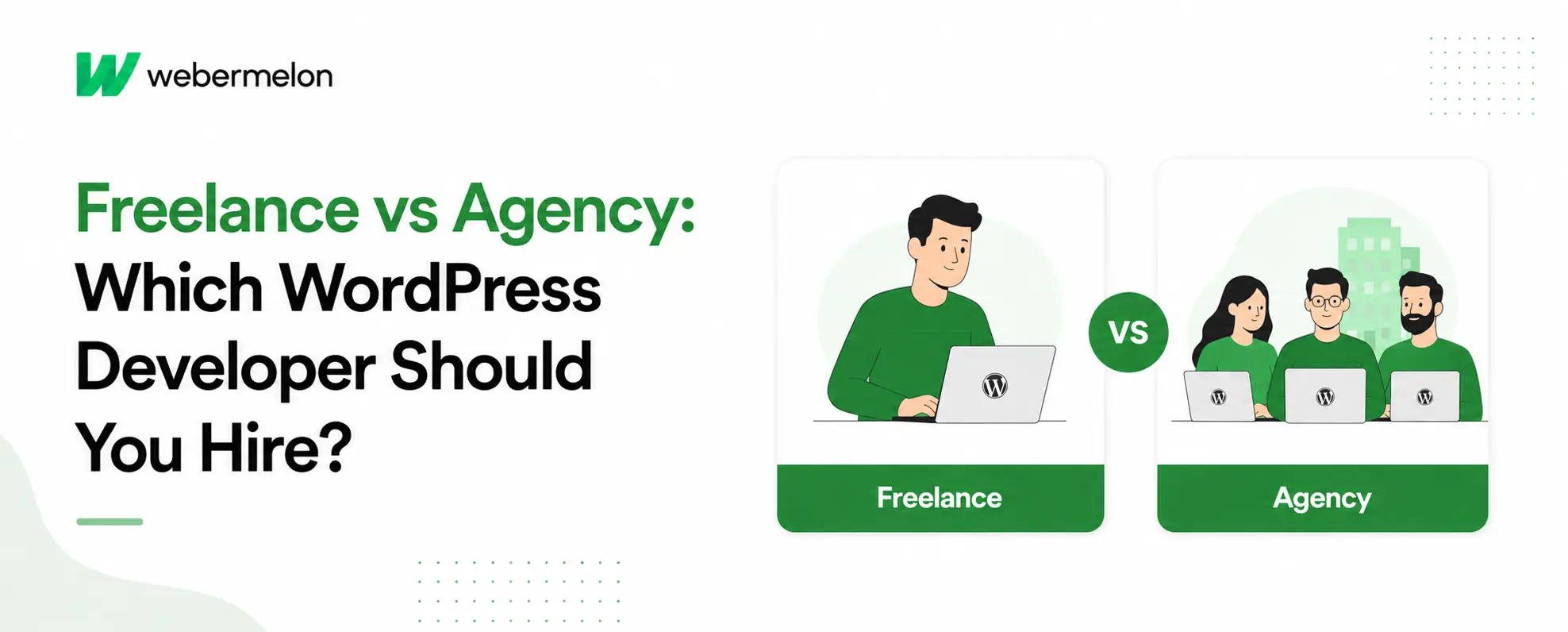
A freelance WordPress developer is an independent professional, typically specializing in one or two areas, such as theme customization or plugin development. A WordPress agency is a team, typically including developers, designers, a project manager, and QA, working under shared processes and a shared accountability model.
That single distinction, one person versus a team, drives almost every other difference you’ll read about in this article. Cost, speed, risk, and scalability all trace back to it.
What Is a Freelance WordPress Developer?
A freelance WordPress developer is a self-employed professional who takes on projects directly, sets their own schedule, and usually works alone. Many specialize narrowly. One developer might be excellent at converting Figma designs into custom Gutenberg blocks but know little about WooCommerce inventory logic.
This specialization can work in your favor if your project aligns with their strengths. It becomes a liability if your project needs skills outside their wheelhouse and they don’t tell you that upfront.
What Is a WordPress Agency?
A WordPress agency is a registered business with multiple people covering different parts of a project: design, front-end development, backend logic, quality assurance, and often a dedicated project manager. You’re not hiring a person. You’re hiring a process.
That process is what you’re paying the premium for. It’s also what keeps a project moving if one team member gets sick, takes a vacation, or leaves the company mid-build.
What Are the Core Structural Differences?
Beyond team size, freelancers and agencies differ in accountability and liability. A freelancer is typically a sole proprietor, meaning that legal recourse, if something goes badly wrong, is limited and personal. An agency is usually an LLC or equivalent entity, carrying business insurance and maintaining a formal contract structure.
This matters more than most people realize until they need it. If a freelancer vanishes with your deposit, your options are slim. If an agency fails to deliver, you have a registered business entity and a signed contract to act against.
How Much Does a Freelance WordPress Developer Cost vs an Agency?
Freelance WordPress developers typically charge $50 to $150 per hour for US-based talent, while WordPress agencies charge $100 to $250 per hour. Offshore freelancers can run as low as $15 to $40 per hour, and offshore-delivery agencies often land between domestic freelancer and domestic agency rates.
Those numbers only tell part of the story. The real cost depends heavily on project type, not just the hourly rate.
What Do Freelance WordPress Developers Typically Charge?
For project-based work, a simple site from a US-based freelancer typically runs $2,000 to $6,000. An offshore freelancer might quote $500 to $2,500 for the same scope, though quality and communication often vary more widely at that price point.
Platforms like Upwork and Toptal remain the most common places to find freelance talent. Toptal screens more aggressively, while Upwork offers higher volume at a wider range of skill levels.
What Do WordPress Agencies Typically Charge?
According to Clutch’s web development pricing data, WordPress agencies typically start project-based pricing at $5,000 to $8,000 for custom work, with blended hourly rates ranging from $100 to $250. Agencies that operate with offshore or distributed delivery teams, including white-label partners like Webermelon, can offer team-based development and ongoing maintenance at rates closer to mid-tier freelancer pricing, while still providing project management and QA coverage.
That gap between “agency” pricing and “freelancer” pricing isn’t fixed. It shifts depending on where the development team is based and how the agency structures its delivery model.
How Does Project Type Affect the Price?
A basic brochure site with five to ten pages sits at the low end for both freelancers and agencies. A custom WooCommerce store with payment integrations, inventory management, and shipping logic costs substantially more, often three to five times as much as a brochure site, regardless of who builds it.
Headless WordPress builds using React or Next.js on the front end drive costs even higher because they require both WordPress backend expertise and modern JavaScript framework expertise. Few solo freelancers cover both well, which is one reason agencies dominate this niche.
Which Option Costs Less Over the Life of the Website?
The cheaper option upfront isn’t always the cheaper option over two or three years. A freelancer-built site with no documentation, inconsistent code standards, or an abandoned mid-build feature can cost more in cleanup than it saved at launch.
Total cost of ownership includes the build, plus ongoing maintenance, security monitoring, and the cost of fixing anything done poorly the first time. Factor that in before comparing sticker prices alone.
If you want a full breakdown of realistic 2026 pricing across project types, our guide on how much it costs to hire a WordPress developer goes into it in more detail.
What Are the Pros and Cons of Hiring a Freelance WordPress Developer?
Freelancers offer lower cost, direct communication, and flexibility, but carry higher risk if they become unavailable or if your project exceeds their specific expertise. Understanding both sides helps you decide whether that trade-off works for your situation.
Why Choose a Freelancer?
You talk directly to the person doing the work. There’s no account manager relaying messages, no meeting about the meeting. For a clearly scoped task, like a speed optimization pass or a specific plugin integration, this directness saves real time.
Cost is the obvious draw. A freelancer’s lower overhead translates into lower rates, and for straightforward projects, you’re not paying for layers of process you don’t need.
What Are the Risks of Hiring a Freelancer?
The biggest risk has a name in the industry: the bus factor. If your one developer gets sick, takes another client, or stops responding, your project stops too. There’s no backup, no second person who knows your codebase.
Freelancers also tend to specialize narrowly. A developer excellent at Elementor builds might struggle with a custom WooCommerce checkout flow, and not every freelancer is upfront about where their skills end.
What Are the Pros and Cons of Hiring a WordPress Agency?
Agencies offer team depth, structured project management, and continuity, but at a higher cost and sometimes with less personal attention than a freelancer relationship provides. The right fit depends on whether your project’s complexity justifies that overhead.
Why Choose an Agency?
You get a full team under one roof: developers, designers, QA testers, and usually a project manager keeping things on schedule. If one team member is unavailable, the project doesn’t grind to a halt because someone else can step in.
This structure also reduces the risk of skill gaps. A developer weak in security can lean on a colleague who specializes in it, something a solo freelancer can’t do.
What Are the Risks of Hiring an Agency?
Higher cost is the obvious trade-off, and for a simple five-page site, an agency can genuinely be overkill. You’re paying for process and redundancy you might not need.
Account manager turnover is a less obvious risk. If your main point of contact leaves mid-project, you may need to re-explain context to someone new, which slows things down even with good internal handoff practices.
Which Option Is Best for Small Businesses?
A freelance WordPress developer is usually sufficient for a small business launching a straightforward informational or brochure-style website. Once the site needs e-commerce functionality, custom integrations, or ongoing strategic support, many small businesses outgrow what a single freelancer can reliably provide.
When Is a Freelancer Enough for a Small Business Website?
If your needs are a clean five-to-ten-page site, a basic contact form, and standard SEO setup, a skilled freelancer can deliver that efficiently and affordably. The scope is bounded, the risk of expansion is low, and you don’t need a project manager coordinating a team for that.
When Does a Small Business Outgrow a Freelancer?
Growth usually triggers the shift. Adding WooCommerce, building a membership area, or needing guaranteed uptime during a product launch all raise the stakes high enough that the bus factor becomes a real business risk, not just an inconvenience.
Which Option Is Best for Large or Complex WordPress Projects?
WordPress agencies are generally better suited to large or complex projects involving custom WooCommerce builds, headless architecture, multi-language sites, or strict security and compliance requirements. These projects benefit from QA processes and cross-functional skill coverage that a single freelancer rarely offers alone.
What Makes a Project Complex Enough to Need an Agency?
Complexity isn’t just page count. A site handling hundreds of SKUs, custom user roles, third-party API integrations, or a decoupled headless front end built in React or Next.js requires multiple specialized skill sets working together, not sequentially through one person’s limited bandwidth.
Can a Freelancer Handle a Complex Project Alone?
Some exceptional freelancers can manage real complexity, but you’re betting the entire project on one person’s range and availability. If anything goes wrong, whether it’s illness, a family emergency, or being overcommitted elsewhere, there’s no team to absorb the gap.
How Do Freelancers and Agencies Handle WordPress-Specific Technical Work?
Agencies generally offer broader technical coverage across custom Gutenberg block development, WooCommerce architecture, and plugin conflict resolution, since different team members can specialize in each. Freelancers often excel in one specific niche but vary widely outside it.
How Do They Differ on Custom Theme and Gutenberg Block Development?
Custom theme development using Gutenberg’s block editor and tools like Advanced Custom Fields (ACF) requires understanding both WordPress’s templating system and modern JavaScript-based block patterns. Agencies that build custom themes regularly, using ACF for flexible content management, tend to develop reusable internal frameworks that speed up future builds, something a freelancer working project-by-project rarely accumulates.
How Do They Handle Elementor or Divi-Based Builds vs Custom Code?
Page builders like Elementor and Divi lower the barrier to entry, enabling more freelancers to offer this work at lower rates comfortably. Custom-coded themes, by contrast, demand stronger PHP and front-end development skills, and that’s where the freelancer talent pool thins out considerably.
Who’s Better Equipped for WooCommerce and E-Commerce Complexity?
A basic WooCommerce store with a handful of products is well within most freelancers’ range. A store with hundreds of SKUs, custom shipping logic, multiple payment gateways, and inventory syncing typically benefits from a team that can split front-end, backend, and QA work in parallel.
How Do They Handle Plugin Conflicts and Core Updates?
When a WordPress core update breaks a plugin or two plugins conflict, diagnosing the issue quickly matters. Agencies with QA processes tend to catch these conflicts before they go live, while a freelancer working solo may only discover the problem after a client reports something broken.
Who Handles Website Maintenance and Security Better?
WordPress agencies typically offer more structured, proactive maintenance and security monitoring than individual freelancers, who may handle updates reactively rather than on a consistent schedule. This is one of the most overlooked factors in the freelancer-versus-agency decision.
What Does Ongoing WordPress Maintenance Actually Involve?
Maintenance covers core and plugin updates, theme compatibility checks, backups, uptime monitoring, and periodic performance audits. Skipping any of these consistently is how sites end up slow, vulnerable, or both.
How Do Freelancers Handle Security Monitoring and Malware Response?
Some freelancers offer maintenance retainers, but coverage is only as reliable as that one person’s availability. If they’re mid-vacation when your site gets compromised, you may be on your own until they’re reachable.
WordPress’s open-source nature makes it a frequent target. Outdated plugins, themes, and especially nulled themes are common entry points for malware, often installed as backdoors that let attackers access a site without login credentials.
How Do Agencies Structure Maintenance Retainers?
Agencies more commonly offer formal maintenance plans with defined response times, proactive monitoring, and a team available even if one person is out. This is where Webermelon’s website maintenance and security services are built specifically to catch issues before they become emergencies, through ongoing monitoring rather than reactive fixes after something breaks.
What Does Maintenance Cost Under Each Model?
Freelance maintenance retainers tend to run at a lower monthly rate but offer less redundancy. Agency retainers cost more but typically include broader coverage: security scanning, performance monitoring, and faster response during an actual incident.
How Do Communication and Project Management Differ?
Freelancers offer direct, often faster communication since you’re talking to the person doing the work. Agencies provide structured communication through a project manager, with more formal timelines and milestone tracking.
What’s It Like Working Directly With a Freelancer?
You email or message the developer directly, and there’s no translation layer. The trade-off is that freelancers juggle multiple clients, so response times can stretch when they’re busy with someone else’s deadline.
What’s It Like Working With an Agency Team and Project Manager?
A dedicated project manager coordinates between you and the technical team, adding a layer and ensuring someone is actively tracking deadlines and deliverables. This structure tends to suit clients who want predictability over informality.
Which Model Fits Your Preferred Level of Involvement?
If you want to be hands-on and make quick calls without waiting for a process, a freelancer is a better fit. If you’d rather hand off a brief and trust a structured workflow to deliver on schedule, an agency’s process-driven approach usually serves you better.
What Happens If Something Goes Wrong?
Both freelancers and agencies have predictable failure modes, and knowing them in advance lets you write a contract that protects you either way. The mistake most businesses make isn’t picking the wrong option. It’s not preparing for what happens when the chosen option underperforms.
What Are Common Freelancer Failure Scenarios?
The most common freelancer failure is simply going quiet: missed messages, missed deadlines, then silence. Scope creep cuts both ways, too. A freelancer might quietly cut corners on a fixed-price project, or a client might keep adding requests without adjusting the budget.
What Are Common Agency Failure Scenarios?
Agencies fail differently. Account manager turnover means having to re-explain your project to someone new. Larger agencies can also be slower to pivot when you need a quick change, since requests often go through a process rather than being executed directly.
How Do You Protect Yourself Contractually?
At a minimum, your contract should cover the scope of work, a payment schedule with milestones rather than full payment upfront, a defined revision policy, and clear ownership of code and assets upon final payment. Any developer or agency uncomfortable putting these terms in writing is worth reconsidering.
Post-launch support terms matter just as much. Know exactly what happens if a bug surfaces a week after launch, and who’s responsible for fixing it without an extra invoice landing in your inbox.
How Do You Vet a Freelancer or Agency Before Hiring?
Vetting either option means reviewing real portfolio work, asking specific technical questions relevant to your project, and watching for red flags during the sales process. How someone communicates before you hire them is usually how they’ll communicate after.
What Should You Ask a Freelance WordPress Developer?
Ask for examples of projects similar in scope to yours, not just a general portfolio. Ask directly how they handle a multi-week absence, whether planned or unplanned, and what happens to your project in that gap.
What Should You Ask a WordPress Agency?
Ask who specifically will be on your project and whether that team is fixed for the duration. Ask about their QA process, since “we test everything before launch” means very little without specifics on how they do it.
What Are the Red Flags to Watch For in Either Option?
Poor communication during the sales process rarely improves after you’ve signed a contract. Be cautious of unrealistic promises, such as guaranteed first-page Google rankings within weeks, and of high-pressure tactics that push you to decide before you’ve had time to think it through.
Is the Hybrid Approach Building Your Own Freelance Team a Good Option?
Some businesses assemble their own team of specialized freelancers, hiring a developer, a designer, and an SEO specialist separately to combine freelancer pricing with broader skill coverage. This can work, but it shifts the coordination burden onto you.
How Does a DIY Freelance Team Work?
You act as your own project manager, hiring each specialist directly and coordinating between them. A lead freelancer sometimes recommends others they’ve worked with before, creating a semi-structured team without formal agency overhead.
What Are the Hidden Risks of Coordinating Multiple Freelancers Yourself?
When something breaks at the boundary between two freelancers’ work, like a plugin conflict between custom code and a designer’s template, you’re the one untangling who’s responsible. Intellectual property and code ownership can also get murky when multiple independent contractors touch the same codebase without clear documentation.
When Does Hybrid Make Sense vs Backfire?
This approach works well if you genuinely have project management experience and time to coordinate. It backfires when you assume it would save you both money and effort, only to discover you’ve taken on a coordination job you didn’t budget time for.
How Should SEO and Technical SEO Responsibilities Be Divided?
Technical SEO factors like Core Web Vitals, site speed, and schema markup should have one clearly assigned owner, whether that’s your developer, your agency, or a separate SEO specialist. Ambiguity here lies in how sites end up with no one actually responsible for performance scores.
Does the Developer Own Core Web Vitals and Technical SEO, or Should That Be Separate?
Many freelance developers focus on functionality and design, leaving Core Web Vitals optimization as an afterthought unless you specify it upfront. Agencies often include baseline technical SEO, such as image optimization and clean code structure, as part of standard delivery, but you should still confirm this explicitly rather than assume it.
How Does This Differ Between a Freelancer and an Agency Engagement?
With a freelancer, you may need to hire a separate SEO specialist and clearly define who owns what, especially around site speed and schema. With an agency, technical SEO is more likely bundled in, though the depth of that work varies significantly between agencies, so ask specifically what’s included.
How Do You Make the Final Decision?
Choose a freelancer when your budget is under roughly $3,000 to $5,000, your project scope is clearly bounded, or you have internal technical know-how to manage the engagement yourself. Choose an agency when your website is a primary revenue driver, the project spans design, development, and QA, or you need defined long-term support after launch.
A Practical Decision Framework Based on Budget, Complexity, and Risk Tolerance
Start with what happens if the build goes wrong or gets delayed. If a missed deadline is mildly annoying, a freelancer’s lower cost and higher risk profile might be worth it. If a missed deadline costs you customers or revenue, that risk tolerance shrinks fast, and an agency’s redundancy starts to look like the smarter spend.
Budget matters, but it shouldn’t be the only lens. A $2,000 freelancer project that needed $4,000 in fixes six months later wasn’t actually the cheaper option.
If you’re leaning toward the team-based route, our guide on how to hire a WordPress developer step by step walks through the process in more detail, and you can also explore what it looks like to hire a dedicated WordPress developer through a team-based model that still gives you a consistent point of contact.
Can You Switch Models Later as Your Business Grows?
Yes, and many businesses do exactly this. It’s common to start with a freelancer for an initial launch, then transition to an agency once the site becomes business-critical or outgrows what one person can maintain. The reverse happens too: a business launches with an agency for a complex initial build, then maintains the site afterward with a freelancer for smaller ongoing tasks.
Final Recommendation
There’s no universally right answer here, only the right answer for your specific project. A freelancer makes sense for bounded, well-defined work where cost matters more than redundancy. An agency makes sense when your website carries real business risk, and you need a team, not just a person, behind it.
Whichever path you choose, put the agreement in writing before work starts. Define scope, payment milestones, and what happens after launch. That single step prevents more freelancer-versus-agency horror stories than any amount of careful vetting beforehand.